November 4, 2026
Custom Aluminum Components: How to Choose Die Casting, Extrusion or CNC Machining
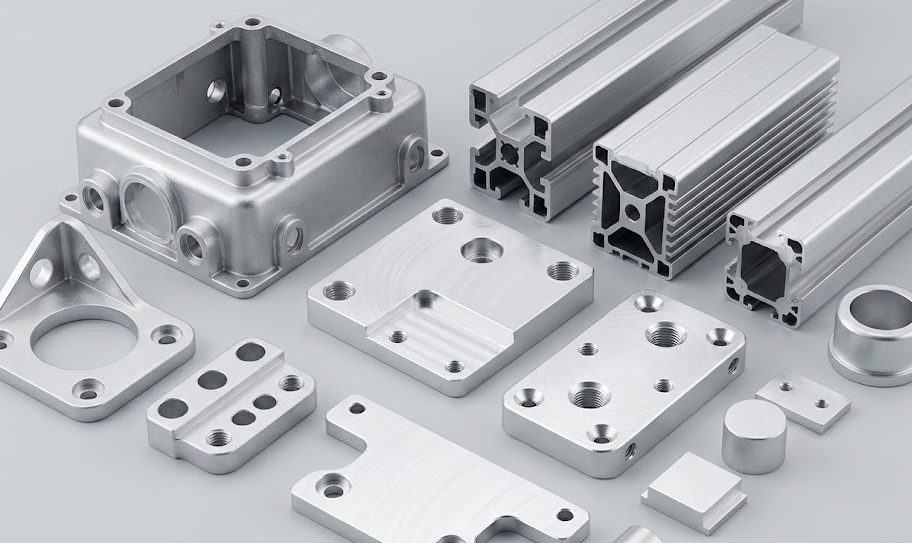
Table of Contents
Table of Contents
Start With the Drawing, Not With the Machine
The Three Routes at a Glance
Step 1: Let Geometry Build the Shortlist
Step 2: Volume and Tooling Decide the Unit Cost
Step 3: Tolerance and Surface Decide the Rest
Alloy Numbers You Can Actually Quote
Secondary Operations Most Buyers Forget to Price
Inspection Steps Worth Requesting
A Short Checklist Before You Send the RFQ
FAQ
Start With the Drawing, Not With the Machine
Many sourcing teams start from a machine list and then try to push the part into one of those machines. It usually works better the other way around. The drawing already contains most of the answer.
A long part with a constant cross-section points to extrusion. A hollow housing with ribs, bosses and drafted walls points to die casting. Tight datums, threads or a sealing face point to CNC machining. In real projects, plenty of custom aluminum components need two of the three, so the honest question is often which step comes first.
Before asking for a quote, write down three things: annual volume, the dimensions that truly control function, and the surface you can accept. Vagueness in any of these is where the later cost surprises come from.
The Three Routes at a Glance
The table below compares the three common production routes used for custom aluminum components. The last row uses the equipment we run ourselves in Changshu, Suzhou, so you can see what a real shop floor looks like behind each route.
Item | Die casting | Extrusion + deep processing | CNC machining |
Shape character | Closed hollow shapes, ribs, bosses, thin walls | Constant cross-section along one axis | Prisms, pockets, faces, holes from solid |
Tooling needed | Die casting tool, longest lead item | Extrusion die, usually the cheapest of the three | No dedicated tooling, only programs and fixtures |
Best-fit volume | Medium to high volume amortises the tool | Profile runs, then cut to length per order | Prototypes, small batches, and finishing of cast or extruded blanks |
Typical alloys | Al-Si-Cu casting alloys such as ADC12 / A380 class | 6xxx series, mainly 6063, 6061, 6005A, 6082 | Wrought plate or bar, or a near-net casting blank |
Dimensional control | Cast tolerance systems such as ISO 8062 apply | Extrusion tolerance standards such as EN 755-9 apply | Tightest of the three; we hold down to +/-0.01 mm |
Secondary work | Trimming, drilling, tapping, impregnation | Cutting, bending, cold drawing, shot blasting, CNC turning | Deburring, then surface finish |
Equipment example on our floor | High-pressure and gravity die casting | 6 aging furnaces of 8-13 m, 4 annealing furnaces of 10 t each | Multi-axis CNC machining centres, milling and turning |
General process and tolerance references are set out in widely used specifications such as ISO 8062 for castings and EN 755-9 for extruded profiles; the equipment figures above come from Suzhou Boding Metal Technology's own production pages at https://www.bd-aluminumprocessing.com/products.
Step 1: Let Geometry Build the Shortlist
Look at wall thickness first. Casting alloys with high silicon content flow well, so they fill thin ribs that extrusion simply cannot produce. But every rib also has to release from the tool, which means draft angles and a parting line.
Next, look at the cross-section along the longest axis. If a single section repeats from one end to the other, extrusion plus cutting is often cheaper per piece than any other route, even after adding holes and slots on a machining centre.
Then check aspect ratio. Very long slender profiles tend to bend and twist during heat treatment, which is why aging furnaces of 8-13 m and straightening steps exist. Very large flat faces, on the other hand, are a machining problem, not an extrusion one.
Step 2: Volume and Tooling Decide the Unit Cost
Tooling is the biggest early gate. A die casting tool costs more and takes longer to build, so it only pays off when you can spread it over volume. Our own reference minimum order quantity is 1,000 pieces per item, and the final number always depends on the quote and the part.
Extrusion sits in the middle. The die itself is relatively low cost, and one profile can serve several product lengths, so the same die can support a whole family of custom aluminum components.
Machining from solid has no tooling gate at all, which makes it the default for prototypes. It also means the unit price barely improves at higher volume, so it loses the race once quantities grow.
A typical production cycle in our plant is 25-35 days after all details are confirmed, and that figure moves with part complexity and order size rather than with the process name alone.
Step 3: Tolerance and Surface Decide the Rest
Tolerance is the most common source of disagreement after delivery. Casting and extrusion standards describe their own tolerance grades; when your drawing asks for something outside that range, the part has to be machined afterwards. Say which surfaces hold the tolerance and which ones only hold a general note.
Our CNC centres hold down to +/-0.01 mm on features that need it, but there is little reason to pay for that on a bracket face. Marking every dimension as critical makes every dimension expensive.
Surface is the second half. As-cast and extruded finishes differ, and cosmetic faces need bead blasting or linishing before anodising. Agree visible from non-visible faces early, preferably on the drawing.
Alloy Numbers You Can Actually Quote
Alloy choice quietly sets both strength and appearance. The table lists the minimum mechanical properties commonly specified for extruded profiles in ASTM B221 and ASTM B221M.
Alloy and temper | Tensile strength, min (MPa) | Yield strength, min (MPa) | Elongation, min (%) | Where it usually goes |
6063-T5 | 160 | 110 | 8 | Architectural and decorative profiles, heat sink bodies |
6063-T6 | 205 | 170 | 8 | Higher strength profiles that still need a clean anodised surface |
6061-T6 | 260 | 240 | 8 | Load-bearing frames, machine parts, welded assemblies |
Source: tensile property requirements in ASTM B221 / ASTM B221M-21, Standard Specification for Aluminum and Aluminum-Alloy Extruded Bars, Rods, Wire, Profiles, and Tubes, ASTM International, https://www.astm.org/b0221m-21.html. Values are specification minimums and change with section thickness, so always confirm against the mill certificate for the actual extrusion.
Two practical notes follow from the table. First, higher strength alloys such as 6061 are harder to extrude into fine detail than 6063, so a profile that looks simple on paper may cost more per metre. Second, T5 and T6 tempers are not interchangeable; T5 comes from press quenching and artificial aging, while T6 goes through full solution treatment, and that difference affects both distortion and final strength.
Die casting alloys behave differently again. Silicon helps fluidity and wear, copper raises strength and machinability but lowers corrosion resistance, and most high-pressure casting alloys are used as-cast rather than heat treated. These are general metallurgical rules widely documented in alloy handbooks, and they are why the alloy should be named in the enquiry, not left to the supplier.
Secondary Operations Most Buyers Forget to Price
A finished component usually passes through several extra steps, and that is where schedule slips happen.
l Heat treatment: T5 or T6 aging in furnaces of 8-13 m, plus annealing in 10 t furnaces. Missing waiting wheels often cost more than processing hours.
l Surface treatment: part and size depend on the anodizing line. We run a 4,000 t/month oxidation line and a 1,500 t/month line for profiles, plus a dedicated parts line and a small anodizing line for precision pieces with tighter control of coating thickness and colour.
l Forming: CNC tube and profile bending, hydraulic pressing, cold drawing of tubes and bars, tube drawing, shot blasting and saponification.
l Joining: MIG, TIG, friction stir welding and robotic welding stations with custom fixture design and fabrication.
l Packaging: export packing design matters more than buyers expect, because anodised surfaces show transit damage clearly.
Ask which of these steps happen in-house and which move to a subcontractor. Every extra loading, transport and re-inspection adds days and risk.
Inspection Steps Worth Requesting
Quality paperwork should match the part's function. For aluminum work the usual set of checks includes the listed items.
l Material analysis with a spectrometer, so the alloy is verified before machining starts.
l Tensile and hardness testing against the relevant standard.
l Salt spray testing for corrosion-sensitive parts, especially after coating.
l Weathering or QUV exposure for outdoor parts.
l Dimensional inspection by full-size scanning or CMM for custom aluminum components with tight datum structure.
Decide acceptance criteria before the first article arrives, not after. First article inspection reports, agreed sampling levels and coating thickness records are much easier to agree up front than to argue about at shipment.
A Short Checklist Before You Send the RFQ
A clean enquiry gets a faster and more accurate quote. Cover these points in one email.
l Drawing in step or PDF plus 3D model, with critical dimensions clearly marked.
l Alloy and temper, or the performance target if you do not know the alloy.
l Annual volume and expected order pattern, including MOQ assumptions.
l Surface finish specification and which faces are visible.
l Testing and documentation requirements, plus any export packing rules.
We also support OEM and ODM projects from concept drawings through to production, including design optimisation and manufacturability review, together with FPD and LCD equipment frames, technical consulting and packaging design.
About This Guide
This article was written by Suzhou Boding Metal Technology Co., Ltd., an aluminum processing manufacturer established in 2019 in Changshu, Suzhou, running more than 5,000 sqm of production space with die casting, extrusion, stamping, CNC machining, anodizing and testing under one management system. We serve customers in sports equipment, power tools, new energy, medical devices, aerospace and automotive sectors in over 30 countries, and we hold our own import and export license.
Every specification mentioned here refers to capability we operate, not a promise for a specific order. Tooling-dependent parameters, tolerance, alloy availability, coating thickness, MOQ and lead time all depend on the actual drawing and quantity, so they must be confirmed in writing with the manufacturer before you place a purchase order.
FAQ
Which process suits small volumes best?
CNC machining from solid, because there is no tooling gate. Once volume rises, an extruded profile cut to length with light machining, or a die casting, usually becomes cheaper per piece.
Can one part combine extrusion and machining?
Yes, and it is very common. The profile gives the cheap cross-section, then CNC turning or milling adds holes, slots, threads and tight faces that extrusion alone cannot hold.
How tight can aluminum CNC machining get?
Our machining centres work to +/-0.01 mm on features that require it. Do not apply that tolerance everywhere; mark only the datums and fits that matter and use general tolerances elsewhere.
Does heat treatment come before or after machining?
Aging to T5 or T6 normally happens on the profile or casting, then finishing cuts follow. Heavy stock removal after aging can release stress and move dimensions, so plan the sequence with the supplier.
What causes the largest schedule risk?
Secondary steps that move outside the main plant: coating, special testing, custom packaging and welding fixtures. Agree responsibility and timing for each one before the production start.