August 11, 2026
Low Density High Rigidity Aluminum Alloy Die Casting, Light Weight To Cut Total Equipment Load, Outstanding Heat Dissipation Performance For Heat Sink Parts
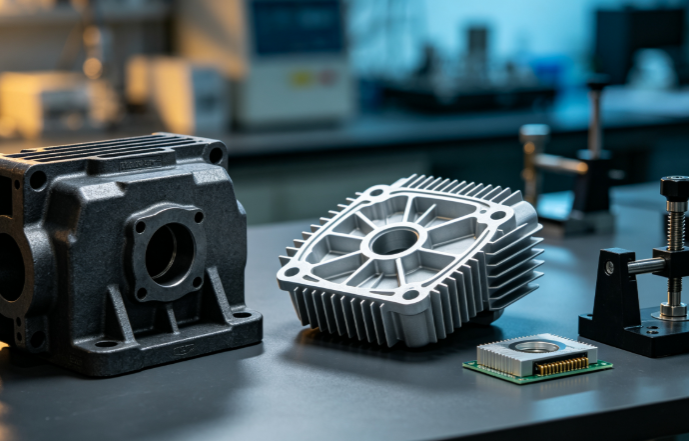
Table of Contents
1. Core Performance Advantages Of Low-Density High-Stiffness Die-Cast Aluminum Alloy
2. Two Core Application Values For Mechanical Equipment 2.1 Ultra-Low Density Greatly Reduce Whole Machine Weight & Overall Load 2.2 Excellent Thermal Conductivity Ideal For All Kinds Of Heat Dissipation Structural Components
3. Standard Die-Cast Aluminum Alloy Grades & Corresponding Application Scenarios
4. Complete High-Pressure Die Casting Production Process For Heat Dissipation Aluminum Parts
5. Performance Comparison: Die-Cast Aluminum Alloy VS Steel / Ordinary Cast Iron Parts
6. Industry FAQ For New Energy, Automation, Motor & Power Equipment Purchasers
1. Core Performance Advantages Of Low-Density High-Stiffness Die-Cast Aluminum Alloy
Aluminum alloy die casting adopts high-pressure hot chamber / cold chamber molding technology, forming integrated complex thin-wall structural parts in one shot. This dedicated low-density high-rigidity die-cast aluminum material has three irreplaceable core properties compared with ferrous metal raw materials: low density, high structural rigidity, and superior heat conduction efficiency. First, its density is far lower than carbon steel, alloy steel and cast iron, effectively cutting self-weight without sacrificing structural stiffness; reinforced rib integrated design further boosts overall rigidity to resist long-term vibration deformation. Second, aluminum alloy has natural excellent thermal conductivity, far better than iron-based materials. The internal dense as-cast tissue without loose pores supports a continuous heat transfer channel, avoiding local heat accumulation on equipment core heating components. Third, high-pressure die casting realizes one-piece integrated forming of irregular heat sink outlines, multi-layer heat tooth structures and mounting boss platforms, no secondary splicing assembly gaps that block heat dissipation. Widely adopted by new energy motor housings, power module heat sinks, automation equipment control box shells, battery heat dissipation brackets and charging pile internal cooling components.
2. Two Core Application Values For Mechanical Equipment
2.1 Ultra-Low Density Greatly Reduce Whole Machine Weight & Overall Load
The density of die-cast aluminum alloy is only about 1/3 of carbon steel and cast iron. Replacing steel or iron structural parts with aluminum die castings significantly lowers total equipment dead load. For mobile devices, transport machinery and robot moving arms, light aluminum castings reduce driving power consumption, extend battery endurance of new energy equipment and cut wear on transmission bearings and slide rails. Even thin-wall integrated aluminum castings retain high overall rigidity through optimized rib layout, no bending deformation under rated dynamic load. Light weight also reduces transportation cost of finished equipment and lowers structural strength requirements for supporting frames and installation bases.
2.2 Excellent Thermal Conductivity Ideal For All Kinds Of Heat Dissipation Structural Components
Metal thermal conductivity of aluminum alloy is dozens of times higher than cast iron and steel. For power modules, drive motors, charging piles and high-frequency heating assemblies, die-cast aluminum heat sinks quickly export internal concentrated heat to prevent overheating shutdown. High-pressure die casting can integrally mold dense array heat sink teeth, deep cooling grooves and flow guide cavities as a single part. No assembly seams exist between heat source contact surface and heat dissipation structure, eliminating thermal resistance gap caused by splicing. Uniform dense casting microstructure avoids internal air holes that block heat transfer; combined with optional surface sandblasting, conductive anodizing treatment, heat exchange efficiency can be further upgraded. Perfect for continuous 24-hour running high-power equipment that demands stable temperature control.
3. Standard Die-Cast Aluminum Alloy Grades & Corresponding Application Scenarios
ADC10 Die-Cast Aluminum
Balanced rigidity, fluidity and heat dissipation performance, cost-effective general grade. Applicable scenarios: Ordinary motor shells, small power module heat sinks, automation equipment lightweight brackets, low-power charging pile cooling housings.
ADC12 High Rigidity Heat Dissipation Die-Cast Aluminum
Higher tensile strength and better thermal conductivity, enhanced dimensional stability after casting. Applicable scenarios: New energy vehicle drive motor casings, high-power inverter heat sinks, industrial robot structural shells, large charging pile integrated heat dissipation components.
A380 High Stiffness Thin-Wall Die-Cast Aluminum
Ultra-low density, outstanding thin-wall forming capacity, lightest weight while maintaining rigidity. Applicable scenarios: Portable power equipment housings, lightweight robot arm heat sink parts, small battery cooling supports, precision automation miniature heat dissipation assemblies.
4. Complete High-Pressure Die Casting Production Process For Heat Dissipation Aluminum Parts
1. Aluminum ingot melting & constant temperature holding: Control molten alloy temperature to maintain uniform fluidity and stable thermal conductivity of finished castings
2. Mold preheating & closed die locking: Preheat mold cavity to avoid cold liquid rapid solidification forming shrinkage pores that damage heat dissipation effect
3. High-pressure fast injection molding: One-step forming of heat sink teeth, mounting bosses, thin-wall main shell and cooling flow grooves
4. Pressure holding & natural cooling: Eliminate internal shrinkage porosity, ensure dense continuous heat conduction tissue
5. Trimming, deburring & stress relief annealing: Remove flash, release casting internal stress to prevent later deformation
6. Precision CNC finish machining: Machine flat heat source contact surface to minimize thermal contact resistance
7. Custom surface treatment: Sandblasting, hard anodizing, conductive oxidation, passivation as heat dissipation and anti-corrosion demands
5. Performance Comparison: Die-Cast Aluminum Alloy VS Steel / Ordinary Cast Iron Parts
表格
Test & Application Index | Low Density High Rigidity Die-Cast Aluminum Alloy | Carbon Steel / Cast Iron Structural Parts | Equipment Operation Practical Impact |
Material Density & Weight | Low density, weight cut by ~67% vs iron | High density, heavy self-weight | Steel/iron parts increase equipment load & power consumption |
Structural Rigidity | Reinforced rib design maintains high stiffness | High basic rigidity but excess weight | Heavy iron parts accelerate bearing wear on moving equipment |
Thermal Conductivity & Heat Dissipation | Excellent continuous heat transfer, no internal pores | Poor heat conduction, easy local overheating | Steel/iron heat sinks cause equipment overheat alarm |
Forming Flexibility | One-piece complex heat sink tooth integrated molding | Multiple split parts need assembly splicing | Splicing gaps create thermal resistance & lower cooling efficiency |
Surface Post-Processing Options | Anodizing, conductive oxidation for enhanced heat dissipation | Only single electroplating anti-rust treatment | Iron parts cannot boost heat exchange via surface modification |
6. Industry FAQ For New Energy, Automation, Motor & Power Equipment Purchasers
Q1: Can die-cast aluminum alloy achieve both ultra-light weight and high rigidity at the same time? A1. Yes. Optimized mold rib layout design improves overall structural stiffness, while low aluminum density drastically cuts self-weight, no bending deformation under standard rated load. Q2: Why die-cast aluminum alloy is the preferred raw material for equipment heat dissipation components? A1. Aluminum has far higher thermal conductivity than steel and cast iron; high-pressure integrated casting eliminates assembly seams between heat source and heat sink to reduce thermal resistance, realizing fast uniform heat export. Q3: Which aluminum alloy grade is best for new energy vehicle drive motor heat dissipation housings? A1. ADC12 die-cast aluminum alloy is the mainstream choice, balancing high rigidity, stable dimensional accuracy and excellent heat dissipation for long-time high-power operation motors. Q4: Will internal pores appear inside die-cast aluminum heat sinks and block heat transfer? A1. Strict molten aluminum temperature control and high-pressure holding process eliminate shrinkage porosity inside castings, forming dense continuous metal tissue for unobstructed heat conduction.
Related articles
May 16, 2026
Friction Stir Welding vs MIG/TIG Welding: Comparison of Metallurgical Quality and Porosity Control in Aluminum Alloy Welding
Read more →May 16, 2026
One-stop processing of aluminum profiles from extrusion to oxidation: How to reduce intermediate transfer losses and improve dimensional consistency?
Read more →April 28, 2025
Choosing Between Aluminum Die Casting and Extrusion: A Practical Framework for Engineers and Buyers
Learn the key differences between die casting and extrusion, including geometry capabilities, strength considerations, and economic factors for process selection.
Read more →April 10, 2025
Beyond the Blank: A Deep Dive into Secondary Stamping and Precision Forming of Aluminum Components
Understand the complete stamping workflow from blanking and deep drawing to fine blanking and post-processing, with practical comparisons to die casting.
Read more →April 15, 2025
The Precise Control of Anodizing: Balancing Coating Thickness and Color Consistency in High-Volume Production
Master the critical control points in anodizing, from coating thickness to color consistency, with special focus on die casting challenges and large-scale production economics.
Read more →April 25, 2025
Aluminum Component Engineering: From Raw Profile to High-Precision Part — A Process Workflow Guide
A comprehensive guide covering the complete workflow of aluminum deep processing, from cutting and bending to precision CNC machining and quality benchmarks.
Read more →