September 20, 2026
Welding and CNC Machining for Large Machine Frames and Equipment Bases
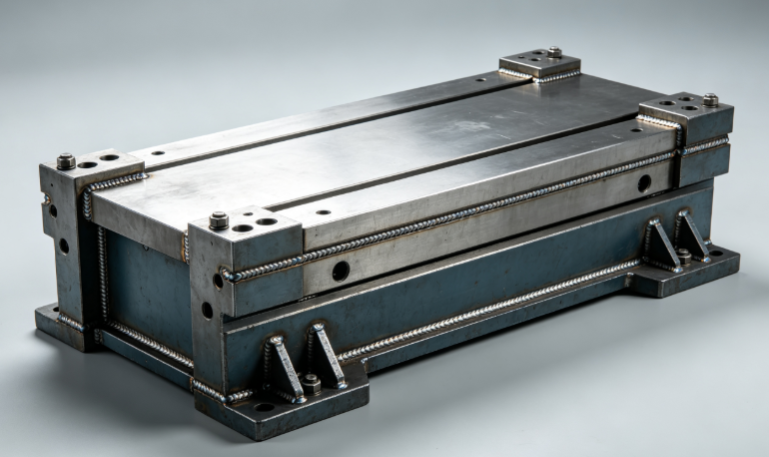
Table of Contents
Introduction
The Integrated Workflow – From Raw Steel to Finished Frame
The Welding Challenge – Thermal Distortion and Its Control
Post-Weld Heat Treatment – Stabilizing the Structure
Precision Machining – Achieving the Critical Tolerances
Equipment Requirements – What It Takes to Machine Large Frames
Shop Welding vs. Site Welding – The Logistics Decision
Conclusion
Frequently Asked Questions (FAQ)
1. Introduction
The large machine frame is the foundation upon which everything else rests. It supports heavy loads, maintains alignment between moving components, and absorbs vibration. If the frame moves, the machine loses accuracy. If the frame distorts, the machine cannot hold tolerance. If the frame fails, the machine stops.
Welding and CNC machining are the two processes that transform raw steel plates into these precision foundations. The welding creates the structure. The machining creates the accuracy. But the two processes are in tension. Welding introduces heat, which warps metal and creates residual stress. Machining removes material, which can release that stress and cause the frame to move. The art of manufacturing large machine frames lies in managing this tension.
This review examines the integrated workflow for welding and CNC machining large machine frames and equipment bases—from fabrication and stress relief to precision machining and final inspection.
2. The Integrated Workflow – From Raw Steel to Finished Frame
Manufacturing a large machine frame is not a single operation. It is a sequence of processes, each building on the previous one. The typical workflow follows a pattern: fabrication, stress relieving, and large-format CNC machining for superior precision.
Step 1 – Cutting and forming. The process begins with high-quality steel plates. CNC cutting—whether flame, laser, or plasma—creates the individual components with precise dimensions. Plates are bent and formed to the required shapes.
Step 2 – Welding. Certified welders assemble the components into the raw frame structure. This is where the frame takes shape. Deep, strong welds provide maximum structural integrity.
Step 3 – Stress relief. Welding introduces residual stresses that can cause the frame to move during subsequent machining. Heat treatment or vibration stress relief reduces these stresses before final machining.
Step 4 – Precision machining. The welded frame is brought onto a large-format CNC machining center. Critical surfaces—mounting faces, guide rails, bearing seats, and bolt patterns—are machined to tight tolerances.
Step 5 – Inspection. The finished frame is verified against the engineering specifications. Three-coordinate measurement ensures dimensional accuracy.
This integrated approach—all operations under one roof—is the distinguishing feature of high-quality frame manufacturing. Shops that offer fabrication, welding, machining, and finishing in-house can control quality at every stage and avoid the tolerance stack-up that comes with outsourcing intermediate steps.
3. The Welding Challenge – Thermal Distortion and Its Control
Welding is the structural backbone of large machine frames, but it is also the source of the most significant manufacturing challenge: thermal distortion. Most industrial frames need to be flat. Welding warps metal.
Why distortion happens. When a weld is deposited, the molten metal contracts as it cools. This contraction pulls on the surrounding base metal, creating internal stresses and distorting the shape of the frame. The effect is more pronounced in large frames because of the volume of weld metal and the long, unsupported sections.
The control strategies. Managing distortion requires a combination of design, technique, and process control:
Weld sequencing. Balanced weld sequencing distributes heat input and minimizes distortion. By alternating weld locations and allowing cooling between passes, the fabricator can control how the frame pulls.
Fixture design. Clamps, tack welds, and braces hold the frame in position during welding. Rigid fixturing prevents movement until the welds have cooled.
Pre-machined weld preps. Preparing the joint geometry before welding ensures consistent weld volume and reduces the risk of distortion.
Robotic welding. Automated welding provides consistent heat input and travel speed, reducing the variability that leads to distortion.
The measurement step. Before CNC machining a welded frame, the deformation after welding must be measured, and the origin of the machining coordinate system determined from the measurement data. This ensures the machining operation removes material from the correct reference points, compensating for any distortion that occurred during welding.
4. Post-Weld Heat Treatment – Stabilizing the Structure
Welding does more than distort the frame—it leaves residual stresses locked inside the metal. These stresses are the result of the thermal cycle: expansion during heating, contraction during cooling. If left in place, these stresses will gradually release over time, causing the frame to move and lose alignment.
The solution. Post-weld heat treatment (PWHT) normalizes residual mechanical stresses before final precision machining. The frame is heated to a controlled temperature, held for a specified time, and then cooled slowly. This allows the internal stresses to relax without changing the microstructure or mechanical properties of the steel.
Why it matters. The effect of PWHT on stability is direct. By normalizing residual mechanical stresses before final precision machining, the critical structural alignments remain stable throughout the entire lifecycle of the component. A frame that is stress-relieved before machining will hold its geometry for decades. A frame that is not stress-relieved will move over time.
Alternative methods. For large structures where heat treatment is impractical due to size, vibratory stress relief (VSR) is an alternative. The frame is subjected to controlled mechanical vibration, which redistributes internal stresses. While not as effective as heat treatment for all applications, VSR can reduce residual stresses in structures that are too large for furnace treatment.
5. Precision Machining – Achieving the Critical Tolerances
Post-weld CNC machining is vital because welding introduces high heat that warps metal and alters dimensions. Precision machining removes this distortion, ensuring that critical mating surfaces and bolt patterns meet tight geometric tolerances that manual fabrication alone cannot achieve.
Why machining is non-negotiable. The welded frame provides the strength. The machined surfaces provide the accuracy. A frame that is welded but not machined will have uneven mounting surfaces, misaligned bolt holes, and inconsistent reference planes. The machine built on that frame will never hold tolerance.
Typical tolerances. For high-precision machine frames, flatness tolerances of ±0.05 mm are achievable on critical reference surfaces. Some shops achieve tolerances down to 0.01 mm in climate-controlled environments. These are the tolerances that enable precision machine tools to produce accurate parts.
The machining sequence. The sequence matters. The preferred approach is to machine the frame after all welding and stress relief are complete. This ensures that the frame is in its most stable state before material is removed. If machining is done before stress relief, the heat treatment will relax stresses and the frame will move, destroying the machined accuracy.
6. Equipment Requirements – What It Takes to Machine Large Frames
Not every machine shop can handle large frames. The equipment requirements are substantial.
Size capacity. Large machine frames require large machining centers. Horizontal boring mills are the workhorses for large frame machining. Some shops can machine parts up to 13.5 meters in length and 2.7 meters in width. Others handle parts up to 8 meters by 4 meters by 4 meters. The machine must be large enough to accommodate the frame and rigid enough to maintain accuracy across the entire work envelope.
Weight capacity. Large frames are heavy. Machining centers must be capable of handling components up to 20 tonnes or more. The table, the spindle, and the fixturing must all be designed for heavy loads.
Precision at scale. The challenge of large-frame machining is maintaining precision across long distances. Thermal growth of the machine, deflection under load, and vibration all affect accuracy. Climate-controlled environments reduce thermal variation. Heavy-duty construction provides rigidity. And closed-loop feedback systems compensate for thermal drift.
7. Shop Welding vs. Site Welding – The Logistics Decision
For very large frames, the question is not whether to weld, but where. Shop welding and site welding each have distinct advantages and limitations.
Shop welding offers controlled conditions, standardized procedures, and consistent quality. The welder works in a dedicated environment with proper ventilation, fixturing, and equipment. The frame can be stress-relieved and machined immediately after welding. The downside is transport—large frames may be too big to move.
Site welding brings the welding to the frame. This eliminates the need to transport large, awkward components. It allows for last-minute adjustments and in-situ problem-solving. The downside is that site conditions are less controlled—wind, rain, and temperature variations affect weld quality. And post-weld heat treatment and precision machining may not be possible on-site.
The practical guidance. Shop welding is preferred for frames that will be precision-machined, because the controlled environment and access to equipment are essential for quality. Site welding is the only option for frames that are too large to transport or for field repairs. When site welding is required, the welders must be qualified, the procedures must be documented, and the quality must be verified.
8. Conclusion
Welding and CNC machining are the two essential processes for manufacturing large machine frames and equipment bases. The welding creates the structural foundation. The machining creates the precision. The two processes are integrated into a sequence: fabrication, stress relief, machining, and inspection.
The challenges are significant. Welding introduces thermal distortion and residual stress. The distortion must be managed through weld sequencing, fixturing, and measurement. The residual stress must be relieved through post-weld heat treatment or vibration stress relief. The machining must be performed on equipment large enough and rigid enough to maintain precision across the entire frame.
The data confirms the importance of this integrated approach. Flatness tolerances of ±0.05 mm are achievable on critical surfaces. Machining centers can handle parts up to 13.5 meters in length. Post-weld heat treatment ensures that structural alignments remain stable for the life of the component.
For engineers and procurement professionals, the message is clear: specify the complete manufacturing route—fabrication, stress relief, and precision machining—as an integrated package. The frame is not just a welded structure. It is a precision foundation.
9. Frequently Asked Questions (FAQ)
Q: Why is post-weld machining necessary for large machine frames?
A: Welding introduces high heat that warps metal and alters dimensions. Post-weld CNC machining removes this distortion, ensuring that critical mating surfaces and bolt patterns meet tight geometric tolerances that manual fabrication alone cannot achieve.
Q: What flatness tolerance can be achieved on a welded and machined machine frame?
A: For high-precision machine frames, flatness tolerances of ±0.05 mm are achievable on critical reference surfaces. Some shops achieve tolerances down to 0.01 mm in climate-controlled environments.
Q: What is post-weld heat treatment and why does it matter?
A: Post-weld heat treatment normalizes residual mechanical stresses in the welded frame before final precision machining. This ensures that the critical structural alignments remain stable throughout the entire lifecycle of the component.
Q: Should I choose shop welding or site welding for a large machine frame?
A: Shop welding provides superior and more consistent weld quality due to controlled conditions and standardized procedures. Site welding is necessary when the frame is too large to transport. For frames that require precision machining, shop welding is strongly preferred.
Q: What equipment is required to machine large frames?
A: Large frames require large machining centers, typically horizontal boring mills. Some shops machine parts up to 13.5 meters in length and handle components up to 20 tonnes.
Q: How is welding distortion controlled in large frames?
A: Distortion is controlled through weld sequencing, rigid fixturing, pre-machined weld preps, and robotic welding. Before machining, the deformation after welding is measured and the machining coordinate system is set accordingly.